Best Psoriasis Treatments in 2026: A Complete Guide to Your Options
Best Psoriasis Treatments in 2026: A Complete Guide to Your Options
Healthy skin renews itself every 28 to 30 days. In psoriasis, that cycle collapses — the immune system misfires, skin cells multiply roughly ten times faster than they should, and the result is the plaques, the scaling, the itch that most patients describe as constant background noise in their lives. An estimated 125 million people worldwide live with this condition. Many of them spend years on the same treadmill: a cream that helps, then stops helping. A referral. A waiting list.
If you've seen a dermatologist — even a few years ago — the plan you left with was probably right for where your condition stood then. But psoriasis doesn't stand still, and neither does the science. What's available in 2026 is genuinely different from five years ago, and some of what's now accessible simply wasn't before.
Psoriasis is a chronic, immune-mediated inflammatory condition affecting the skin and, in around 30% of cases, the joints — a manifestation known as psoriatic arthritis. There is currently no cure, but there are effective treatments that can control the condition, substantially reduce symptoms, and for many patients achieve clear or near-clear skin. There is no single best psoriasis treatment; what works depends on type, location, and severity, your medical history, and your lifestyle. The goal of this guide is to give you enough of a picture to discuss your options properly with a dermatologist or GP.
Prescription Treatments: What Doctors Recommend
For most people, treatment starts with a GP or dermatologist appointment and a topical prescription. But the full range of what can be prescribed extends considerably further.
The Treatment Pathway: A Structured Escalation
Psoriasis is managed through a treatment pathway that advances by response: when one treatment no longer provides adequate control, the next is considered. The NICE Guideline CG153 on Psoriasis: Assessment and Management sets out this framework — from topical treatments through to phototherapy, conventional systemics, and biological therapies.
In practice, the pathway typically moves as follows:
-
Emollients and topical treatments — first-line
-
Phototherapy (NB-UVB) — when topicals are insufficient or not tolerated long-term
-
Conventional systemic treatments — methotrexate, ciclosporin, acitretin
-
Biological therapies and newer oral agents — for moderate-to-severe or refractory psoriasis
Not every patient moves through all four steps, and the pathway is not always linear — severity, location, and access all influence where a dermatologist begins.
Topical Treatments
Topical corticosteroids are the most commonly prescribed treatment for mild to moderate psoriasis. They reduce inflammation and slow the overproduction of skin cells, and are available in a range of potencies and formulations — ointments, creams, gels, lotions, and foams — allowing treatment to be matched to the affected area. They tend to relieve symptoms quickly, but long-term use carries risks including skin thinning. Stopping abruptly after prolonged use can trigger a rebound flare, so gradual tapering is recommended.
Vitamin D analogues — most commonly calcipotriol — regulate skin cell growth and are frequently combined with topical corticosteroids in a single formulation. Unlike steroids, they don't carry the risk of skin atrophy with prolonged use. Effects typically become visible after around four weeks of uninterrupted treatment, and calcipotriol should not be applied to facial skin. The most common side effects are local irritation, itching, and a burning sensation at the application site.
For sensitive areas — the face, skin folds, genitalia — topical calcineurin inhibitors (tacrolimus, pimecrolimus) offer a steroid-free alternative that doesn't carry the risk of skin atrophy. A mild burning sensation in the first few days is common and typically settles.
Keratolytics: Preparing the Skin for Treatment
Salicylic acid softens and loosens the thickened scale on psoriatic plaques, both relieving discomfort and improving the absorption of treatments applied afterwards. For heavily crusted lesions, it is often the logical first step in a topical sequence rather than an afterthought. Stronger preparations used long-term can cause irritation, so guidance on concentration and duration is advisable.
Coal tar preparations — available in shampoos, creams, and bath additives — reduce scaling and slow skin cell turnover. Coal tar shampoos in particular are widely used for scalp psoriasis and available over the counter; stronger formulations are on prescription.
Emollients
Emollients — fragrance-free moisturising creams and ointments containing active ingredients such as urea — are a core part of daily skin management in psoriasis. They restore the skin barrier, reduce itching and scaling, and improve the penetration of topical treatments applied afterwards. Applied to slightly damp skin immediately after bathing, and allowed to absorb before any medication is used, they work most effectively as part of a consistent daily routine. Emollients will not treat psoriasis, but their role in symptom management and treatment support is consistently underestimated.
Phototherapy
Phototherapy is a medical treatment that uses ultraviolet light at a specific wavelength, delivered in a controlled and measured way, to produce therapeutic effects on the skin. It is one of the most established treatments in dermatology — used for psoriasis for over 30 years — and it works: a 75% reduction in psoriasis severity (PASI 75) is achieved in the majority of patients who complete a full course of treatment.
Narrowband UVB (NB-UVB) phototherapy — delivered at 311 nm — is an established second-line treatment endorsed in major dermatological guidelines across Europe. It reduces local skin inflammation and slows the accelerated skin cell renewal that causes plaque formation, typically over a course of 20 to 30 sessions at three per week. Traditionally, receiving NB-UVB meant attending a dermatology clinic for every session — a real barrier for many patients. CE MDR Class IIa certified and MHRA-listed home devices now make it possible to receive the same clinical treatment without attending a clinic. UV Tactus is one such device — delivering hospital-level NB-UVB phototherapy at home.
PUVA (psoralen plus UVA) is an alternative phototherapy approach, combining UVA irradiation at 320–400 nm with a photosensitising agent — psoralen — taken orally or applied to the skin before treatment. It is generally considered when NB-UVB has not produced sufficient results, and carries a higher cumulative risk profile with long-term use, including an increased risk of skin cancer. It is delivered in a clinic setting.
Systemic Treatments
Where phototherapy is not appropriate or has not produced sufficient results, systemic treatments — methotrexate, ciclosporin, acitretin — are the next step. Depending on the medication, they are taken orally or administered by injection. Common side effects include effects on liver and kidney function, which is why regular blood monitoring is required throughout treatment. All three carry significant contraindications in pregnancy. These are treatments to discuss carefully with a specialist before starting.
Biologics
Biological therapies represent the most significant advance in psoriasis treatment over the past two decades. Derived from human or animal proteins and designed to resemble the body's own, they target the disease mechanism precisely — blocking the overactivated immune response by reducing T lymphocyte activity or decreasing immune cells in the skin, joints, and blood. They do not cure psoriasis, but can substantially reduce or eliminate symptoms and, where joints are affected, may help prevent joint damage that would otherwise be permanent. They are given by subcutaneous injection.
TNF-alpha inhibitors (adalimumab, etanercept, infliximab) block a cytokine that drives skin cell proliferation and joint inflammation, and are also used in rheumatoid arthritis and Crohn's disease. Newer-generation biologics target interleukins elevated in psoriatic skin and joints — IL-17 inhibitors (secukinumab, ixekizumab), IL-23 inhibitors (risankizumab, guselkumab), and ustekinumab (IL-12/23).
Oral Small Molecules
Oral small molecules are a distinct class of systemic treatment — chemically synthesised drugs taken as pills that target specific intracellular signalling pathways involved in psoriasis inflammation. Unlike biologics, which are large protein molecules given by injection, small molecules work from within the cell to interrupt the inflammatory process. A real option for patients who need systemic treatment but want to avoid injections.
Apremilast (PDE4 inhibitor) works by blocking an enzyme involved in inflammatory signalling, reducing the production of pro-inflammatory cytokines. It does not require blood monitoring and has a more manageable safety profile than traditional systemic treatments.
Deucravacitinib (TYK2 inhibitor) is a newer and more selective option, targeting a signalling pathway central to the action of IL-12, IL-23, and type I interferons in psoriasis.
Both biologics and oral small molecules are prescribed for moderate-to-severe psoriasis according to eligibility criteria, determined through specialist assessment and national prescribing guidelines. Because they act on the immune system, they carry the potential for side effects including increased susceptibility to infection, and require careful individual assessment and ongoing monitoring. Suitability is always evaluated on an individual basis by a specialist before treatment begins.
The most effective psoriasis treatment is rarely the most powerful one — it is the one that fits your severity, your health profile, and your life.
New and Emerging Psoriasis Treatments
Recent years have brought progress on more than one front. The LITE Randomised Clinical Trial (JAMA Dermatology, 2024) confirmed that home NB-UVB phototherapy is non-inferior to clinic-based treatment across all skin tones — providing the clinical evidence that validates home phototherapy devices now bringing this long-established therapy to patients who cannot access a clinic.
The drug development pipeline has also been active. Two 2025 results are worth knowing about.
Zasocitinib, a next-generation oral TYK2 inhibitor developed by Takeda, delivered strong phase 3 results in December 2025 — achieving PASI 75 and PASI 90 in over 50% of patients at week 16 across two large trials, outperforming apremilast across all 44 secondary endpoints, as reported by Dermatology Times. It is not yet approved by any regulatory authority; submission is planned for 2026.
For a specific and severe subtype — generalised pustular psoriasis (GPP) — spesolimab (Spevigo) was recommended by NICE in June 2025 as the first targeted treatment for GPP flares in adults in England and Wales, as set out in NICE guidance TA1070. GPP is a rare form in which pustules appear across large areas of the body and requires urgent medical attention. The first targeted therapy for this group — and a long time coming.
Beyond the clinical pipeline, many patients also explore what they can do alongside prescribed treatment — through natural approaches, dietary changes, and lifestyle adjustments.
Natural Treatments and Lifestyle Adjustments
Lifestyle adjustments matter in psoriasis management — not as a replacement for prescribed treatment, but as a way to reduce triggers, support what you're already taking, and improve day-to-day symptom control. Left unmanaged, they can worsen the condition and raise the risk of cardiovascular disease, obesity, and type 2 diabetes — complications that get less attention than the skin, but matter just as much.
Triggers to avoid
Several factors are consistently associated with psoriasis flares and poorer treatment response:
-
Alcohol — frequent consumption can trigger flares and interact with psoriasis medications, reducing their effectiveness or increasing the risk of side effects.
-
Smoking — worsens symptoms and increases cardiovascular risk, which is already elevated in psoriasis.
-
Stress — a well-established flare trigger. If stress is proving difficult to manage, psychological support is worth seeking.
-
Excess weight — patients who are overweight tend to have more severe psoriasis and a reduced response to treatment, including biologics. Modest weight loss has been shown to improve outcomes in clinical research.
Diet and Nutrition
No single diet treats psoriasis, but an anti-inflammatory approach is broadly supported: reducing alcohol, ultra-processed foods, and excess sugar; increasing oily fish, vegetables, and whole grains. The Mediterranean diet is associated with lower systemic inflammation and reduced cardiovascular risk. For patients with coeliac disease, a strict gluten-free diet is essential; it is not routinely recommended for others. Vitamin D supplementation may help where a deficiency is confirmed — discuss with your GP. Omega-3 fatty acids have shown modest anti-inflammatory benefit in some trials. Vitamin B12 has been proposed as a supportive supplement, though clinical evidence remains limited; supplementation is only advisable where a deficiency is confirmed.
Natural Topical Approaches
Some natural applications may offer symptomatic relief used alongside prescribed treatment. Topical aloe vera has shown possible benefit in small trials for reducing erythema and scaling. Dead Sea salt baths may reduce scaling and inflammation for some patients. Turmeric (curcumin) has attracted interest for its anti-inflammatory properties, with preliminary trial data suggesting possible benefit, though the evidence base remains limited. Natural oils such as coconut or sunflower oil can help with skin moisture and comfort. None of these replace medical treatment, but they can sit alongside it.
At-Home Treatments That Actually Work
Beyond prescription treatment, there's a range of things patients can manage at home — from over-the-counter products for day-to-day symptom control, to the most significant development in home psoriasis care in recent years: clinical-grade NB-UVB phototherapy, now available outside the clinic, including for the scalp and face.
Home Phototherapy: Clinical Access, Without the Clinic
NB-UVB phototherapy is an established, dermatologist-prescribed treatment for psoriasis — recommended in major clinical guidelines as a second-line option when topical treatments are insufficient. For decades, it was available only in a clinical setting, requiring patients to attend three sessions per week over several weeks. For many, that level of access was simply not realistic. The LITE Randomised Clinical Trial (JAMA Dermatology, 2024) followed 783 patients across 42 clinical sites and confirmed that home NB-UVB phototherapy produces outcomes equivalent to clinic-based treatment across all skin tones. The BAD/BPG 2022 guidelines specifically recommend home NB-UVB as an option where access barriers — such as waiting times or geography — make clinic attendance impractical.
Home devices certified to clinical standards now make this straightforward.
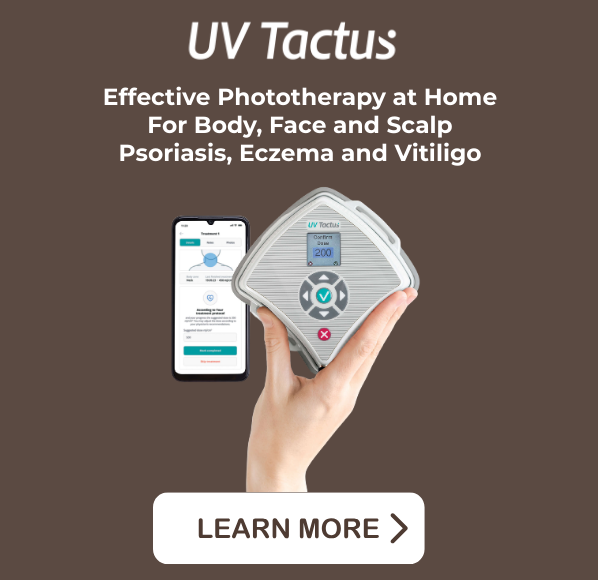
UV Tactus is a CE MDR Class IIa certified and MHRA-listed home NB-UVB phototherapy device that makes it possible to receive this dermatologist-approved treatment at home. The device operates at 311 nm using LED technology and an integrated dosimeter that measures treatment dose in mJ/cm² in real time — the same unit used in hospital phototherapy — stopping automatically when the prescribed dose is reached. This ensures clinical-grade accuracy, removing the reliability problem of timer-based devices where accuracy degrades as lamp intensity diminishes over time. The accompanying UV Tactus app supports treatment consistency, helping patients follow a personalised protocol, track sessions, and maintain the structured approach that effective phototherapy requires — mirroring the clinical setting at home.
UV Tactus is designed to treat various body areas, including the scalp and face — areas that can be particularly difficult to manage consistently. Because it is available at home, patients can use it whenever treatment is needed, without the need to travel to a clinic. It is also practical for preventative or maintenance treatment when advised by a dermatologist, helping to sustain skin clearance and manage the condition more proactively.
Choosing the Right Treatment for You
The right starting point depends on how severe your psoriasis is and where it appears. If you have mild psoriasis, topicals are usually where you begin. If those aren't enough — or aren't tolerable long-term — phototherapy or systemic treatments come into the picture. Severe disease, or psoriasis that's significantly affecting your quality of life, is more likely to warrant biologics. And severity isn't just about how much skin is covered: if your psoriasis is consistently disrupting your sleep, your work, or your mental health, that counts clinically even when the affected area looks limited. Dermatologists use validated tools — PASI and DLQI — to assess this properly rather than relying on surface area alone.
Your age, medical history, current medications, lifestyle, and practical factors like cost and access all shape what's actually right for you. What works well for someone else may be wrong for you, or just not sustainable.
A few things hold regardless of where you are in the pathway. Daily emollient use isn't optional — it applies whatever else you're taking. If you're at the moderate-to-severe end, topicals tend to work alongside phototherapy or systemic therapy, not instead of them; using them in isolation often means undertreatment. And managing triggers — alcohol, stress, excess weight — matters more than most people expect. Even treatments that work well work less well when these are left unaddressed.
The Decision Is Yours — But You Should Have the Full Picture
Psoriasis is manageable. Not always easily, and not always without some trial and error — but the gap between what many patients are enduring and what's actually achievable is often wider than it should be. The treatments exist. The question is whether your current plan is making use of them.
If it's not working as well as you'd like, or if you haven't had a review in a while, that's reason enough to go back. What was available five years ago is not what's available now. A plan that wasn't working then might work now — and one that is working might have room to work considerably better. Across all of it, lifestyle management matters more than most people give it credit for: controlling triggers, keeping up with daily skin care, following treatment consistently. These aren't footnotes to the plan; they're part of it.
The right treatment is rarely a single intervention. It's a plan built with a dermatologist, matched to where you are now — and revisited as things change.
This article is for informational purposes only and does not constitute medical advice. Always consult a qualified dermatologist or GP before starting, changing, or stopping any treatment.
F.A.Q.
There's no single answer, because 'most effective' depends on severity, where the psoriasis appears, your overall health, and what's actually accessible to you. For mild disease, topical therapies tend to work well. For moderate-to-severe disease, the bar shifts — phototherapy and systemic treatments are where the stronger evidence sits. The best treatment is the one that fits your specific picture, which is why a dermatologist's assessment matters. What worked — or didn't work — five years ago may not reflect what's available now.
There is no known cure. However, many patients achieve clear or near-clear skin with the right treatment, and extended remission is achievable for many.
Some — aloe vera, Dead Sea salt baths, dietary changes — may provide symptomatic relief for some patients. None replace prescribed treatment. Always discuss supplements or topical remedies with your dermatologist before adding them.
Psoriasis itself is not life-threatening, but it is associated with conditions carrying real health consequences: psoriatic arthritis (in around 30% of cases), cardiovascular disease, metabolic syndrome, and depression. Keeping psoriasis well controlled has implications that extend well beyond skin appearance.
everity is classified as mild, moderate, or severe based on the location and extent of lesions, and their impact on daily life and wellbeing. A dermatologist assesses severity using the Psoriasis Area and Severity Index (PASI), or body surface area (BSA) where PASI cannot be applied, alongside the Dermatology Life Quality Index (DLQI), which is based on a patient questionnaire. When both PASI and DLQI scores are 10 or below, psoriasis is considered mild and is typically managed with topical treatments and phototherapy. When either score exceeds 10, the disease is classified as moderate-to-severe, and systemic treatments are generally more appropriate. Severity is not only about surface area — psoriasis affecting visible or sensitive areas, or consistently disrupting sleep, work, or mental health, may warrant more intensive treatment even when the affected area appears limited.
A dermatologist should be consulted whenever psoriasis symptoms appear for the first time, before starting any new treatment or changing an existing one, and whenever the current approach is not delivering the results you need — whether the disease is spreading, affecting your daily life, or simply not well enough controlled. Joint pain alongside skin symptoms is a particular reason to seek specialist input promptly, as it may indicate psoriatic arthritis. If some years have passed since your last review, a referral is worth requesting even if your condition feels stable.
What trips people up most often is assuming the treatment options they were given years ago represent the full picture. They rarely do. Psoriasis management has genuinely moved on, and if your current plan isn't controlling the condition well, it's worth asking a dermatologist whether something else might work better.


