Scalp Psoriasis: Understanding the Early Signs and Treatment Options
Scalp Psoriasis: Understanding the Early Signs and Treatment Options
Scalp psoriasis has a way of making itself the loudest thing in the room. The relentless itch. The thick, silvery scale that no shampoo quite shifts. The way it creeps past your hairline when you least expect it. If you've been living with it for a while, you likely already know what it is — but understanding how the full range of treatment options works, and how they build on one another, can make a real difference in how well you manage it.
What Is Scalp Psoriasis?
Scalp psoriasis is a chronic, inflammatory skin condition caused by an overactive immune system — and one of the most common skin disorders worldwide.
How Psoriasis Affects the Scalp
It affects the scalp and frequently extends to the hairline, forehead, back of the neck, and the skin behind and around the ears — often spreading well beyond the hair border to the entire scalp and surrounding areas. It is one of the most common presentations of psoriasis: research published in peer-reviewed literature consistently indicates that up to 80% of people with psoriasis experience scalp involvement at some point. For some, the scalp is the only site affected. For others, it is one patch of skin among many across the body.
Scalp psoriasis cannot be cured permanently. It is a chronic condition that can be effectively controlled — and for many patients, long periods of remission are achievable — but understanding this from the outset shapes more realistic expectations.
Types of Psoriasis
Psoriasis is not a single, uniform disease. It presents in five clinically distinct forms, and several further presentations affecting specific areas of the body are also commonly seen in clinical practice. The type you have influences which treatments are most appropriate.
Plaque Psoriasis
Plaque psoriasis is the most common form, affecting 80–90% of all people with psoriasis. It produces raised, inflamed patches of skin covered with a silvery sheen of white scale — and scalp psoriasis is most frequently a manifestation of this type. Plaques on the scalp can range from fine scaling across a small patch of skin to thick, adherent scale covering the entire scalp. This is the form most people are referring to when they talk about psoriasis on the scalp.
Guttate Psoriasis
Guttate psoriasis produces small, drop-shaped scaly spots scattered across the body, typically triggered by a streptococcal throat infection. It is more common in children and young adults and can resolve on its own, though it sometimes develops into chronic plaque psoriasis over time.
Inverse Psoriasis
Inverse psoriasis develops in skin folds — the armpits, groin, and under the breasts — where friction and moisture produce smooth, inflamed, reddish patches without the typical thick scale seen in other forms.
Pustular Psoriasis
Pustular psoriasis is characterised by white pustules surrounded by inflamed, reddish skin and can be localised or more widespread across the body. It is less common than plaque psoriasis but can be more difficult to manage, particularly when it affects the palms, soles, or — in generalised cases — large areas of the body.
Erythrodermic Psoriasis
Erythrodermic psoriasis is the rarest and most severe form, causing extensive redness, peeling, and shedding across large areas of skin. It can disrupt the skin's ability to regulate temperature and act as a barrier against infection. It requires urgent medical attention.
Nail Psoriasis
Nail psoriasis affects the fingernails and toenails rather than the skin itself, causing pitting, discolouration, thickening, and separation of the nail from the nail bed. About half of people with psoriasis experience some degree of nail involvement, a proportion that rises further among those who go on to develop psoriatic arthritis. It can occur alongside any of the skin-based types above, and nail involvement is associated with a significantly increased risk of psoriatic arthritis — making it worth mentioning to your dermatologist even if it seems like a minor cosmetic issue.
Palmoplantar Psoriasis (Hands and Soles)
Palmoplantar psoriasis specifically affects the palms of the hands and the soles of the feet, producing thickened, often painful plaques or pustules in these high-friction areas. Because the skin here is thicker and under constant pressure from daily activity, this presentation can be particularly disruptive to everyday life and frequently requires a tailored treatment approach.
Early Signs and Symptoms of Scalp Psoriasis
Psoriasis Symptoms: What Sets Scalp Psoriasis Apart
Scalp psoriasis is regularly mistaken for seborrhoeic dermatitis or ordinary dandruff — particularly in its earlier stages. The distinction matters because the treatments are different, and using the wrong one provides no real benefit.
The characteristic psoriasis symptoms to look for on the scalp include:
-
Reddish patches of inflamed skin visible at the hairline, behind the ears, or at the nape of the neck
-
Thick scale with a silvery sheen, often leaving visible patches of white skin where flakes lift away, more adherent than typical dandruff flakes
-
Intense itching, which can range from a persistent irritation to something that disrupts sleep
-
Fine scaling or scaly spots in milder presentations, which can easily be mistaken for dandruff
-
Raised plaques — thickened patches of skin that may crack when very dry
-
Dry skin, scale, and flaking extending beyond the hairline onto the forehead and neck
Seborrheic dermatitis produces yellowish, greasier flakes and tends to affect oilier areas including the nose and eyebrows. Scalp psoriasis produces drier, whiter scale with more sharply defined edges. These common symptoms overlap enough that a professional assessment is often the only reliable way to distinguish them — and it is worth getting right, because scalp psoriasis is frequently undertreated as a direct result of misidentification.
Causes and Common Triggers
What Causes Scalp Psoriasis
Psoriasis is not contagious. It is not caused by poor hygiene or anything you have done. It is an immune-mediated inflammatory skin condition in which the immune system mistakenly accelerates the skin cell cycle. In healthy skin, new skin cells take around 28 days to mature and shed from the skin surface. In psoriasis, this cycle compresses to as few as three to five days — causing skin cells to pile up on the surface faster than they can shed, producing the characteristic thick scale and plaques. This skin cells pile-up is what gives scalp psoriasis its visibly thickened, scaly texture. T-cells drive this inflammatory process, triggering a cascade that sustains the abnormal turnover of skin cells in the affected areas.
Genetic predisposition plays a significant role — a first-degree relative with psoriasis meaningfully increases your risk. But genes alone do not determine when or how severely the condition presents. Scalp psoriasis may also appear for the first time during a period of significant stress or illness, even in people with no known family history.
Known triggers that can provoke or worsen flare-ups include:
-
Psychological stress — one of the most consistently reported triggers
-
Skin trauma (the Koebner response: new lesions appearing at the site of injury)
-
Certain medications, including beta-blockers, lithium, and antimalarials
-
Streptococcal throat and other skin infections
-
Hormonal changes
-
Alcohol consumption
-
Diet, including processed and high-sugar foods in some individuals
-
Cold, dry weather
-
Smoking
Every patient responds differently. Identifying your own pattern — through a simple flare diary tracking diet, stress, illness, and skin events — is one of the most practical steps you can take. Organisations such as the National Psoriasis Foundation provide flare-tracking tools and resources that can support this process.
How Scalp Psoriasis Is Diagnosed
How Doctors Diagnose Scalp Psoriasis
There is no blood test for psoriasis. Diagnosis is primarily clinical: a dermatologist will examine the affected areas visually and take a detailed patient history, considering the distribution and character of the lesions, family history, and associated symptoms. Joint pain, for example, can signal psoriatic arthritis — an inflammatory joint condition that affects up to 30% of people with psoriasis and requires its own management.
Where the diagnosis is uncertain — when scalp psoriasis closely resembles seborrhoeic dermatitis or a fungal condition — a skin biopsy may be taken: a small sample of skin examined under a microscope to confirm what is driving the changes to the skin surface.
If a scaling or itching scalp condition has not responded to standard dandruff shampoos after a few weeks, a referral to a dermatologist is worth pursuing. Early, accurate diagnosis means earlier access to treatments that address the underlying inflammatory skin condition — not just its surface appearance. Being able to catch scalp psoriasis before scale and inflammation become extensive generally makes it easier to bring under control.
At-Home Care and OTC Treatments
Mild Scalp Psoriasis: Where to Begin
For mild scalp psoriasis or as a foundation alongside prescription treatment, consistent daily management with over-the-counter options can make a meaningful difference. The key is regularity — not intensity.
Mild psoriasis often responds well to consistent OTC care without needing prescription treatment straightaway, though the decision between OTC or prescription medications should always factor in how widespread and persistent the symptoms are.
Moisturising the entire scalp regularly is one of the most underrated steps. Lightweight, fragrance-free sprays or lotions applied to a dry or slightly damp scalp reduce dryness, soften plaques, and prevent the cracking that worsens discomfort. Natural options such as coconut oil or olive oil can help soften thick scale before washing — applied to the affected areas, left under a shower cap for 30–60 minutes, then rinsed with a medicated shampoo. Their evidence base is limited compared to licensed active ingredients, but many patients find them useful as part of a broader care routine.
Medicated Shampoos and Coal Tar Products
When it comes to scalp psoriasis shampoo options, two active ingredients have the most established clinical evidence:
Coal tar is one of the oldest scalp psoriasis treatments available without prescription. Beyond slowing the abnormal rate of skin cell production and reducing inflammation, coal tar also acts as a keratolytic — helping to soften and loosen the protein bonds holding scale together, alongside its antipruritic effect on itching. A coal tar shampoo works best when applied to a wet scalp, massaged in, left for several minutes, and then rinsed — not used as a quick wash-and-go product. Some patients find a tar shampoo drying with regular use; rotating with a gentle, sulphate-free shampoo helps manage this. As with any treatment, it's worth checking with a pharmacist or dermatologist that coal tar is suitable for the severity of your scalp psoriasis.
Salicylic acid acts as a keratinolytic — it softens and loosens thick scale so it can be cleared more easily from the skin surface. This matters because scale acts as a physical barrier, reducing how effectively any subsequent treatment, whether OTC or prescription, can penetrate through to the skin. Pre-treating with a salicylic acid product before applying other treatments is consistently recommended in clinical dermatology practice.
One practical step that is often overlooked: avoid scratching. Scratching damages the skin surface and can trigger the Koebner response — creating new lesions at the site of trauma. It also worsens temporary hair loss. Treating the itch at its source is more effective than managing it at the surface.
Medical Treatments for Scalp Psoriasis
When over-the-counter management provides insufficient control, or when scalp psoriasis is moderate to severe, prescribed treatments are the appropriate next step to treat scalp psoriasis effectively. There are three main categories, each with a distinct mechanism and a different place in the treatment pathway.
Topicals
Prescription topical treatments for the scalp are formulated as lotions, solutions, foams, and gels designed to penetrate through hair to reach the skin surface.
Topical steroids — corticosteroids — are the most frequently prescribed treatment for scalp psoriasis, reducing inflammation and slowing cell turnover in the affected areas. They are used in short higher-strength courses during active flares and at lower strength for maintenance. Vitamin D analogues (most commonly calcipotriol) normalise the abnormal rate of new skin cell production and are often prescribed alongside a corticosteroid, as the two mechanisms complement each other. Calcineurin inhibitors such as tacrolimus offer a non-steroidal option where long-term steroid-free management is the goal.
For all topical treatments, scale acts as a barrier. Pre-treating with a salicylic acid or urea-based product to soften plaques before applying prescription medications significantly improves their penetration and efficacy — regardless of hair type. Hair itself also adds a practical challenge: thicker or longer hair can make it harder to part sections evenly and apply treatment directly to the skin rather than coating the hair shaft, which is part of why scalp-specific formulations — lighter lotions and solutions that flow through to the scalp more easily than thick creams — are generally preferred.
Phototherapy
When topical treatments are insufficient, not tolerated, or when a patient wants to reduce their reliance on prescription medications, phototherapy is the evidence-based next step — and a particularly practical one for scalp psoriasis, even though hair itself presents the same barrier here that it does with topicals: thick or dense hair can block UV light from reaching the skin in the same way it can prevent a cream from making proper contact with a plaque. This is largely addressed with a comb attachment, which parts the hair and directs light straight through to the skin surface — making home phototherapy practical for the scalp. Phototherapy can also be very effective for the areas scalp psoriasis often extends into — the hairline, forehead, neck, and ears — where hair is not a barrier and the light reaches the skin directly.
Narrowband UVB (NB-UVB) at 311 nm is the gold-standard therapeutic wavelength used in dermatology worldwide. It works by slowing the accelerated skin cell turnover at the core of psoriasis and modulating the immune response that drives it. The 2022 British Association of Dermatologists and British Photodermatology Group guidelines establish NB-UVB as a recommended, evidence-based treatment for psoriasis more broadly, with detailed recommendations covering both clinic-based and home-based delivery when a medical-grade device with correct dosing is used. The landmark LITE Randomised Clinical Trial (JAMA Dermatology, 2024), involving 783 patients across 42 clinical sites, confirmed that home-based NB-UVB phototherapy is non-inferior to office-based treatment across all skin tones.
Many dermatologists recommend a combination approach — topical treatment, phototherapy, and a consistent daily scalp care routine working together — to get the best results.
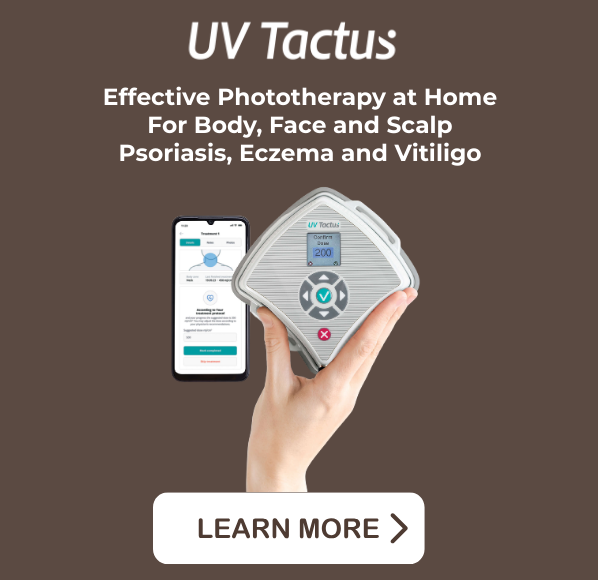
With a comb attachment purpose-built for scalp treatment, UV Tactus brings this same clinic-grade approach into the home. It is a CE MDR Class IIa certified portable NB-UVB medical device, suitable for treating not only the scalp but also adjacent areas such as the hairline and neck, as well as smaller patches and larger areas of psoriasis elsewhere on the body. Its companion app organises a dedicated scalp treatment plan, guiding each session step by step, tracking progress, and allowing results to be shared with a treating dermatologist. Standard protocol is three sessions per week, with early changes in scale and itching typically visible within the first few weeks; optimal results build over a full treatment course of around 25 to 30 sessions.
Systemics (Oral & Biologics)
For patients with severe scalp psoriasis, widespread body involvement, or disease that has not responded adequately to other treatments, systemic options are available to treat psoriasis at a deeper, immune level. Oral medications such as methotrexate and ciclosporin suppress the overactive immune response. Biologic therapies — injectable medicines that target specific inflammatory pathways — represent a significant advance for appropriate patients with severe cases.
These are reserved for more severe or resistant disease, require specialist prescribing, and carry a different benefit-risk profile to topical and light-based treatments.
Psoriasis-Related Hair Loss and Recovery
Temporary hair loss associated with scalp psoriasis arises primarily from the condition itself, not its treatments. Heavy scale build-up across the entire scalp, persistent inflammation in the affected areas, and repeated scratching can all disrupt the hair follicle cycle and trigger shedding — a process known as telogen effluvium.
This form of hair loss is almost always non-scarring and reversible. Once inflammation is controlled and the scalp heals, regrowth generally follows. The priority is to treat promptly, handle hair gently during active flares, and avoid products containing sodium lauryl sulphate, strong fragrances, or alcohol — ingredients that aggravate an already sensitised scalp and can prolong the time it takes for the skin to recover.
Preventing Flares and Long-Term Management
Managing Flare-Ups: What the Evidence Supports
You cannot prevent psoriasis. The underlying predisposition does not disappear. What structured, consistent management can do is reduce how often flare-ups occur and how severe they are when they do.
Stress management is one of the most evidence-supported strategies, since psychological stress is among the most consistently reported triggers. Regular physical activity, adequate sleep, and structured approaches to stress all appear to reduce flare frequency. Cleansing and hydrating the scalp regularly — with a gentle or medicated shampoo and a fragrance-free moisturiser between washes — helps reduce scale accumulation and dryness before either becomes difficult to manage. Dietary patterns also play a role: excess alcohol and diets high in processed food appear to worsen disease activity in susceptible individuals, while omega-3 fatty acids and adequate vitamin D have supporting evidence as adjuncts to treatment.
After a successful treatment course, maintenance therapy extends remission. Reducing phototherapy to one or two sessions per week, or applying topicals to recurrence-prone areas twice weekly, can prevent flare-ups from re-establishing — a pattern well recognised in clinical practice. And over time, tracking what precedes your flares creates a personalised picture that turns a chronic, unpredictable condition into one that is genuinely more manageable.
Managing scalp psoriasis well means understanding which part of the treatment pathway you are on, what comes next when the current approach stops delivering, and why the next step is justified by evidence. That pathway — from OTC coal tar products and salicylic acid shampoos through to prescription topicals, targeted phototherapy, and advanced biologics — is better mapped and better evidenced than it has ever been. None of it replaces the basics, either: a daily scalp routine of gentle cleansing and hydration, alongside awareness and management of your own triggers, remains the foundation that every other treatment builds on. Knowing your options, and working alongside a dermatologist to apply them, is what makes long-term management genuinely possible.
This article is for informational purposes only and does not constitute medical advice. Always consult a qualified dermatologist or healthcare professional before starting, changing, or stopping any treatment for psoriasis.
F.A.Q.
No. Psoriasis is an immune-mediated inflammatory skin condition driven by the body's own immune system. It cannot be transmitted through any form of contact.
No treatment currently available can cure scalp psoriasis permanently. It is a chronic condition, but effective management — through topical treatments, phototherapy, or systemic medications — can achieve long periods of remission and significantly improve quality of life.
In most cases, yes. Temporary hair loss caused by scalp psoriasis is almost always non-scarring and reversible once the underlying inflammation is controlled and the scalp heals. Treating the condition promptly and keeping the scalp free of heavy scale helps support recovery.
Yes. Psoriasis can develop at any age. At least a third of adults with psoriasis first experienced symptoms before the age of 16, and scalp involvement is common in paediatric cases. NB-UVB phototherapy can be used in children under appropriate dermatological guidance.
Consistently, yes. Psychological stress is one of the most frequently reported triggers for psoriasis flare-ups, with the risk of flares correlating with the severity of stress experienced. It does not cause the condition, but in those who already have it, sustained psychological stress can provoke and prolong episodes.


